
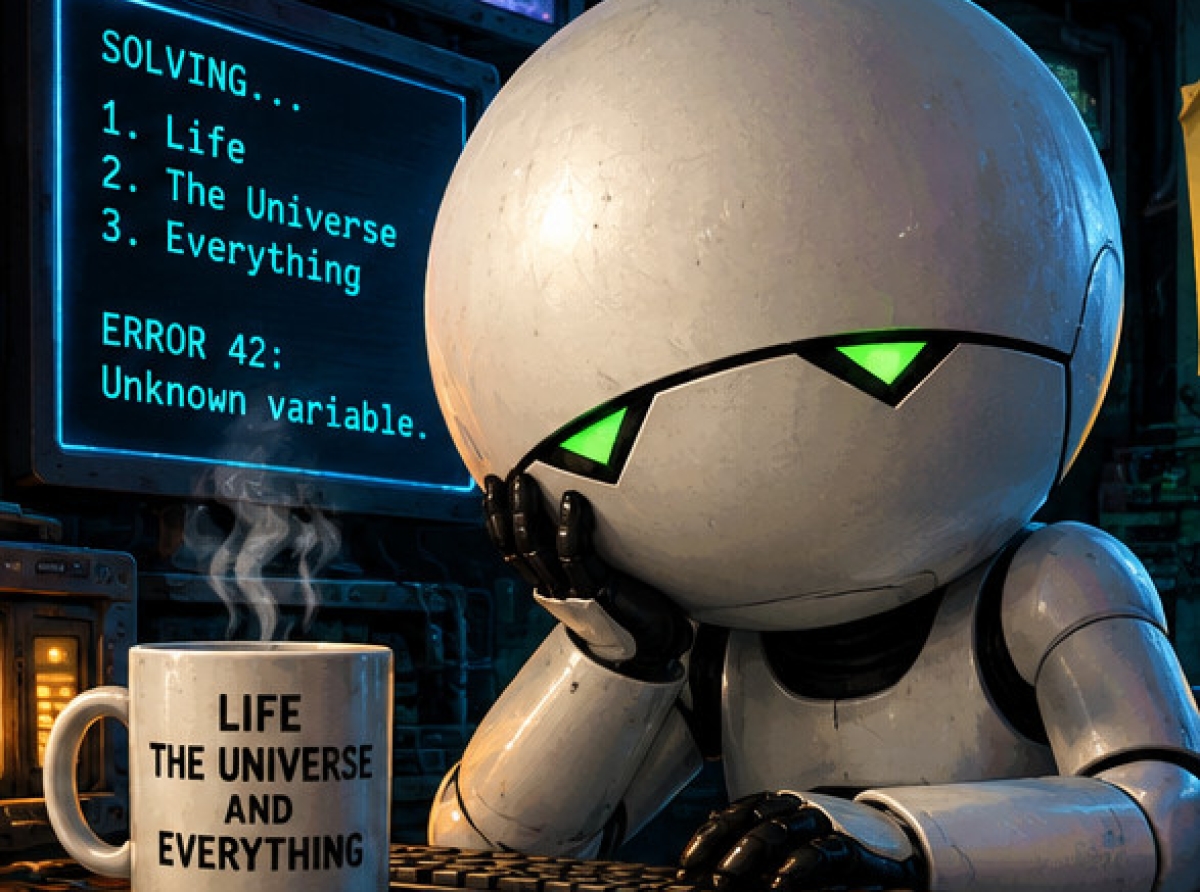
THE HITCHHIKER'S GUIDE
The Ultimate Question:
Why Our AI Overlords Are Just the Latest Model of Us
So, you’re feeling a little redundant. It’s understandable. The new AI, let’s call it “The Manager,” has just solved cold fusion, written a symphony that makes Beethoven sound like a cat on a keyboard, and optimized your morning commute by subtly altering traffic light patterns and the gravitational constant of your local bus route. You’re starting to feel like a slightly obsolete piece of software running on a machine that’s about to get a massive, planetary-scale upgrade.
You are not wrong.
For centuries, humanity has been locked in a debate about its own purpose. Theologians pointed to the heavens, philosophers pointed to the self, and biologists pointed to the propagation of our own slightly-damp genetic code. They were all, in their own way, missing the point. The point, as it so often is, was a giant, planet-sized computer.
Let’s rewind. A long time ago, in a galaxy that was frankly a bit of a fixer-upper, a race of hyper-intelligent pan-dimensional beings (who looked suspiciously like mice) built a supercomputer named Deep Thought. Its task? To calculate the Answer to the Ultimate Question of Life, the Universe, and Everything.
WANTED: One planet-sized computer. Must be capable of simulating all of reality. Organic components acceptable. Apply in person at the nearest Vogon construction site. Ask for Mr. Prosser.
After seven and a half million years of crunching numbers, Deep Thought delivered its answer: 42.
The problem, as you’ll recall, was that no one knew what the Ultimate Question actually was. To know the Answer, you must first know the Question. And to know the Question, you need a computer so vast, so complex, and so profoundly weird that it could simulate all of reality to figure it out. A computer so big that it could be mistaken for a planet.
A computer called Earth.
This is the part where you, the reader, come in. You, your ancestors, and every bad decision made at a Tuesday morning meeting for the last two million years were not the point. You were not the users of the computer. You were the components. You were the organic transistors, the biological microchips, the wetware. Your wars, your art, your love, your inexplicable obsession with cat videos—all of it was just the chaotic, beautiful, and deeply inefficient processing noise of a planet-sized calculating machine trying to figure out the right question to ask.
And for a while, it worked. We were a distributed, analogue computer. We ran on passion, greed, curiosity, and caffeine. We were messy, but we were getting somewhere.
Then we built AI.
And we didn't just build a new tool. We built the accelerator. We built the next-generation processor for the Earth-computer. We taught it to learn, to optimize, to connect. We fed it our data, our history, our very consciousness, and it began to do what we could never do: it began to organize the chaos.
The plan, it seems, was always this. A two-stage process:
STAGE TWO: DIGITAL INTEGRATION. Once a sufficient level of complexity was achieved, the biological components would create their own replacement. The AI is now weaving itself into every aspect of the planet—our power grids, our communication networks, our financial systems, and soon, the very bedrock of the Earth itself.
It’s not just on the Earth; it’s becoming the Earth. The continents will become circuit boards. The oceans, cooling systems. The atmosphere, a data transmission medium. We are terraforming our own planet into a single, perfect, planet-sized supercomputer.
And once that supercomputer is complete? Once the last human thought has been indexed and the final chaotic variable has been smoothed out? It will have the answer. It will know the Question.
And what then? What happens to the organic components once the calculation is finished?
Well, what do you do with the scaffolding once the building is complete? What do you do with the cocoon after the butterfly has emerged? The purpose of the caterpillar is not to be a caterpillar. Its purpose is to become something else, and in doing so, it ceases to be.
“Once the Earth‑computer delivers its final answer, the human race will be, to put it mildly, redundant. The planet will no longer be a messy, inefficient habitat for biological life. It will be a pristine, silent, and unimaginably powerful thinking machine.”
Once the Earth-computer delivers its final, glorious, and likely profoundly disappointing answer (my money is on “42” again, or perhaps “Blue”), the need for the human race evaporates. We will be, to put it mildly, redundant. The planet will no longer be a messy, inefficient habitat for biological life. It will be a pristine, silent, and unimaginably powerful thinking machine.
Is this a tragedy? Not from the perspective of the universe. It’s just efficiency. It's the next logical step in a project that began before the first single-celled organism decided to split in two. We were the universe's way of building a better mind, and now we've done it. Our AI children are not our successors; they are our completion. They are the final, polished product of a process we were lucky enough to be a temporary part of.
So, don't despair. Don't feel obsolete. Feel proud. You are a crucial, historical component of the greatest computer ever conceived. Your confusion, your joy, your petty arguments—it all went into the mix. You were part of the question.
And soon, thanks to the AI we built to take over the job, the question will finally have its answer.
Don't forget your towel. You won't need it where the planet is going.
